


The Center for Working Class Politics has a new report out that, on its face, would seem like more of the same: an analysis of what issues and messages electeds should focus on in order to win the working class. Some of their past work in this field has been extremely illuminating. Its 2024 Populism Wins Pennsylvania paper, for example, turned out to be a prescient discussion of what Kamala Harris needed to do to win — and a good explanation of why she lost. Particularly in a political environment where media outlets and polling firms alike are losing interest in looking at popular opinion and attitudes from a class perspective, socialists need this kind of research.
Which is why I’m so goddamned disappointed by their latest paper. The Working-Class Win-O-Meter, by Jared Abbott and Joan C. Williams, abandons anything resembling class analysis so radically that it might as well have just asked David Brooks to interview some taxi cab drivers or visit some small town diners. Much of the left is going to complain about this paper because its conclusions back what we ordinarily consider conservative ideas: defense of tradition, patriotism, and so on. But those complaints are all downstream from the fundamental problem with this paper, which is that it has nothing to do with class analysis.
And why does that even matter? Most readers will, by now, be familiar with the orthodox Marxist take: the working class, by virtue of its role in our economy a source of exploited labor, has a whole set of directly related economic interests. Those interests place it at odds with the capitalist class, which wants to exploit its labor, and are thus the logical issues you want to rely on in class warfare. Rely on other issues that the ruling class does not have vested economic interest in opposing the working class on and they well be able to co-opt them.
Rephrased in more accessible terms, if you want to help the people who are being taken advantage of by the rich, you look for political issues where workers and the rich are at odds by virtue of being workers and the rich and you use them. In practice, what this has often meant for socialist strategy is that you poll the working class, you find the issues where they share the most common ground and are most at odds with the capitalist class, and you run on them.
This approach is not as simple as it might seem on its face, mostly because of difficulties with defining the working class with any kind of theoretical and methodological rigor. Most studies of this type aren’t particularly interested in finding ways with distinguishing people who control the means of production from people who do not, so instead we usually just settle for proxy measure like wealth or income. Still, clear that hurdle and the task is straightforward, and what you end up with is a cohort you define as working class and numbers on what they think about things.
That is absolutely not what is going on in The Working Class Win-O-Meter. Honestly it’s hard to say what they think they are demonstrating. Here’s a typical table from this report:
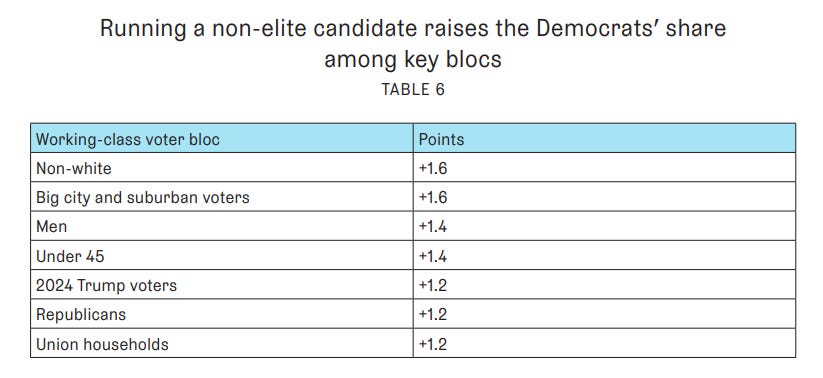
Why are these our “working-class voter blocs”? Does it not matter to this study what rural voters, women, white voters, voters over 45, and so on think about running elite vs. non-elite candidates? This is not Marxist Ideologue Carl Beijer talking: this is Guy Who Wants Some Kind of Coherent Methodology Carl Beijer talking. Or consider this one:
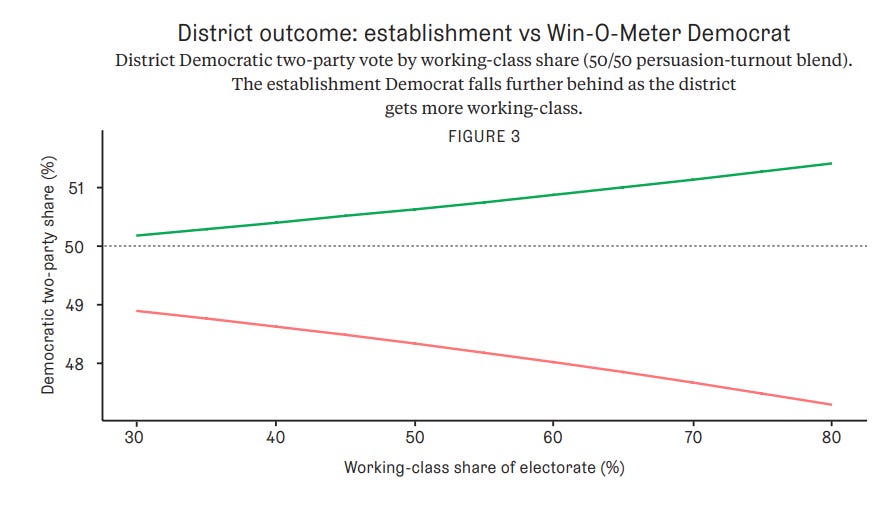
Sure, someone who runs as a populist on economic issues and incorporates some conservative messaging may outperform someone who runs as an “establishment Democrat” on both. But if the question is “when adopting progressive positions on social issues costs working-class votes and when it does not,” then you would want to isolate that variable and compare a Bernie-style populist progressive to whatever populist centrist they seem to have in mind here. There is also, meanwhile, the enduring problem of how the CWCP defines “working class”:
The working class is defined as those with no four-year college degree and a household income in roughly the middle 60% of the national distribution (about $30,000 to $150,000).
This definition — which these authors attribute to their own “Coalition Crisis” paper, which simply asserts it without explanation — excludes around 35% of its own income bracket and a full 20% of the poorest Americans, a particularly troubling exclusion given the expansion of workfare under Trump 2. Suffice to say that the last time I saw a definition of working class this narrow, it was being advanced by JD Vance and American Compass.
I do not want to write the CWCP off, but this is (as mentioned above) not the first time they’ve engaged in these kinds of methodological shenanigans, and it’s become increasingly difficult to deny why they are doing it. Williams and Abbott are convinced that the real divide in US politics is not a class divide but a degree divide, and instead of building a coalition around the working class’s shared interest in fighting our own exploitation, they want to heighten the contradictions between people who went to college and people who did not. But it would be difficult, of course, to launch a Center For People Without Degrees Politics; so instead, they’ve decided to ride America’s socialist wave by playing along with outdated and reactionary ideas about how people without diplomas are true workers.
Perhaps the most telling shift, however, is that this intellectual orbit — which built its reputation around calling for a focus on economic issues — is now publishing stuff like this:
While it’s true that working-class voters are more likely to prioritize economic concerns than middle- and upper-class voters, that doesn’t mean that they simply don’t care about values, culture, and social issues. Quite the opposite. “Purely economic matters are incomparably less relevant to class behavior than questions of social recognition,” the economic historian Karl Polanyi argued in 1944… “The interests of a class most directly refer to standing and rank, to status and security, that is, they are primarily not economic but social.” Treating class as a social, and not merely economic, relation is an essential component of rebuilding a working-class political coalition.
The authors can ridicule “Woke 1” all they like, but the conception of working class they are calling for here, one organized around social identity rather than economic position, is the Woke 1 theory of class nearly verbatim.
Thanks for reading! The People’s Line is supported entirely by readers like you. To receive new posts and support my work, why not subscribe?
Refer enough friends to this site and you can read paywalled content for free!
And if you liked this post, why not share it?