



Credible accusations of sexual assault against Maine Democrat Graham Platner have almost certainly destroyed his campaign for Senate. While Platner hasn’t dropped out of the race yet, CNN suggests that it’s just a matter of time.
Platner’s campaign has been embroiled in scandal from the beginning, but there has been a strange disconnect between what the real red flags were and what people were willing to criticize him for. Shortly after his campaign launch, for example, I argued that he should drop out simply because he was on record criticizing socialism and had not disavowed the comments. Platner had also killed multiple people in Afghanistan as a private military contractor, was vocal about how much he enjoyed the experience, and even defended desecrating the corpses of America’s enemies. These are not things that hawkish, anti-socialist liberals were ever going to take serious issue with, but they should have been dealbreakers for the left.
Instead, for most of the campaign the liberal case against Platner focused on less compelling criticism. Though Platner claimed that he didn’t know what it was and eventually had it removed, for example, liberals directed much of their attention to his Totenkopf tattoo. When that failed to maintain any kind of traction, they began constructing tortured and factually inaccurate arguments that Platner was unappealing to working class voters. And predictably, partisans of Israel insisted all along that he was an anti-semite — placing the left in the awkward position of having to defend him against that particularly toxic line of rhetoric.
One of the strangest complaints about Platner, however, simply revolved around the fact that he is “aesthetically” working class:
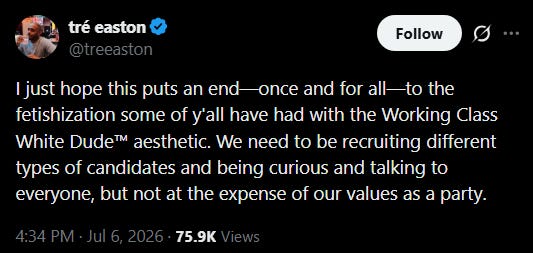
This complaint is particularly ironic coming from the former legislative director for Senator Fetterman, who has famously made much more of an effort than anyone else in the Senate to present himself as working class. Platner, of course, did too; though he is well-off, he went out of his way to wear hoodies and grow out a beard.
Two things I find odd about this line of criticism, however. The first is that there just isn’t much evidence that people backed Platner because of his working class presentation. The only poll on this that was even remotely relevant, taken in May, noted that only 3% of respondents thought Platner’s background was “important”. Research suggests that working class identification can give a candidate a roughly 6% bump among working class voters — but Platner’s edge was closer to 20%.
Polls certainly indicated that support for Platner was driven by the usual concerns about cost of living and the economy in general. There is, however, no evidence that it was Platner’s working class aesthetics that drove confidence in his campaign on these issues. A better explanation, I suspect, can be found in the literature on a similar stereotype applied to black voters: that they will reflexively vote for black candidates based wholly on shared identity. In 2020, for example, Wamble and Clemons noted, regarding Kamala Harris and Corey Booker, how
Many political observers presumed [Kamala Harris and Cory Booker]… to have an advantage among Black voters by virtue of shared racial identity.
This is a recurring premise in liberal identitarian rhetoric: groups always vote as monoliths, and they always prefer shared identity. Republicans have often insisted upon this too, pressing the narrative that black voters just reflexively vote as a hivemind for other black people, even when it’s against their interests. But as Wamble and Clemons continue,
Black voters are not going to just give Black candidates positive evaluations no matter what they do…Black politicians are not significantly more likely to receive overly positive evaluations for supporting policies that align with the group’s interests, such as calling out prejudicial behavior, than White politicians are for doing the same.
It’s not hard to guess why so many people think otherwise, of course. If you have a condescending view of black intelligence then you are more likely to suspect them of engaging in groupthink and shallow, identity-based reasoning. Neither, in that light, is it difficult to discern why so many liberals harbor such suspicions about working class voters.
That point becomes especially clear when we consider the second thing I find curious about all this: how we evaluate Platner’s support compared to support for people who do not present as working class. Consider disgraced former Congressman Eric Swallwell. The crimes that Swalwell engaged in were if anything far more egregious, and yet we never head speculation about voters being willing to overlook them because of his class presentation.
Why? Because Swallwell presented himself as a member of a class people like Easton actually approve of. Swallwell wore tailored suits and expensive designer glasses; even when he dressed casually, he preferred the look of a Palo Alto weekend warrior with pastel-colored button-ups and fleece vests. He was always carefully groomed with news anchor hair and, at the very most, a respectable but understated shadow of beard stubble. Swallwell looked like 80% of the men you run into on Capitol Hill or in the C-suite.
There is not a serious problem in our country of indulgence towards the working class when they commit crimes, but there is one with men who look like respectable professionals getting away with all kinds of things. So why weren’t liberals making this point when the accusations surfaced about Swallwell? Why didn’t we get lectures about how Swallwell supporters were all rubes that were suckered in by his GQ aesthetics? I think you know why.
Refer enough friends to this site and you can read paywalled content for free!
And if you liked this post, why not share it?