Responsibility and death under socialism
Taking on another ideological strawman.
Not quite from the mailbag, but this one is as long as some of the emails I receive:
I think there is something genuinely morbidly curious in how socialists like to talk about "social murder" and it is an incredibly important part of their ideology, while ML societies were genuinely a negative example of all of this in a really puzzling way and they have zero interest in it.
This one is in response to my article last month on how the destruction of PEPFAR signifies yet another round of mass death under capitalism — so it is, in other words, a complete non-sequitur. And does not, of course, happen to be true. In my case, I chose my undergraduate program precisely because I wanted to study under Vasily Aksyonov, whose socialist parents were killed by the Soviet government. Years ago when I lived in Ukraine I went out of my way to visit multiple Holodomor memorials, and in Russia I had some fascinating conversations about Commander Zhukov’s objections to Stalin’s reckless military tactics. In reality I have probably spent far more time thinking about deaths under socialism than folks like Devin have, and almost certainly more than he’s spent thinking about deaths under capitalism.
The fact is that socialism did kill a lot of people. And it is to socialism’s credit that we can say this: that we can so easily attribute so many deaths to the decisions of particular socialists, and then decide whether they were justified or not. This makes it a much more transparent and accountable system that capitalism, which kills even more people and then completely evades responsibility, either blaming the victims or the impersonal machinations of fate. And then, of course, if you try to point any of this out, the response will be exactly what Devin did here: to pretend that you are the one avoiding responsibility.
Let’s return to the example of the Holodomor, since that has always been Exhibit A of the case against socialism. Though the USSR did experience inclement weather (particularly in 1932), research suggests that this likely contributed to only a small fraction of excess mortality in those years. Over the last few decades, scholarship has made it clear that a number of agricultural practices during collectivization set the famine in motion: overfarming leading to soil depletion, poor seed rationing, and so on. When the famine began, the Soviet government refused to accept reductions in Ukraine’s grain exports; and when Ukrainians attempted to hoard grain to survive, Soviet authorities cracked down and left them to starve.
One reading of these events, advanced by historians like Graziosi, holds that the Holodomor was essentially a failed exercise in central planning that spiralled out of control into a brutal imposition of triage and counterinsurgency at the expense of Ukrainians. This seems utterly plausible to me; the documetary record, and internal correspondence in particular, tells an entirely familiar story of govenrment officials shifting from blind denial to ruthless damage control. The alternative take, accepted without skepticism by most US liberals, sees elements of deliberate conspiracy in the famine, with a particular focus on instances of ethnic bias against Ukrainians.
The second explanation seems must more shaky to me, but one thing that everyone should be able to agree on: Stalin himself took responsibility for what he called a “mechanistic approach to the last collection plan”. Stalin himself repeatedly refused to significantly lower export quotas. And it was Stalin who came to see Ukraine’s failure to produce its quotas as a sign of rebellion that had to be put down.
From there, you can go on to attribute responsibility for particular incidents and outcomes to other officials as well; you can identify particular local officials, for example, who suggested that growing cannibalism in Ukraine was a reflection of their barbaric nature rather than a reflection of widespread starvation. Since the socialist state takes responsibility for economic outcomes it is trivially easy to attribute them to various state actors.
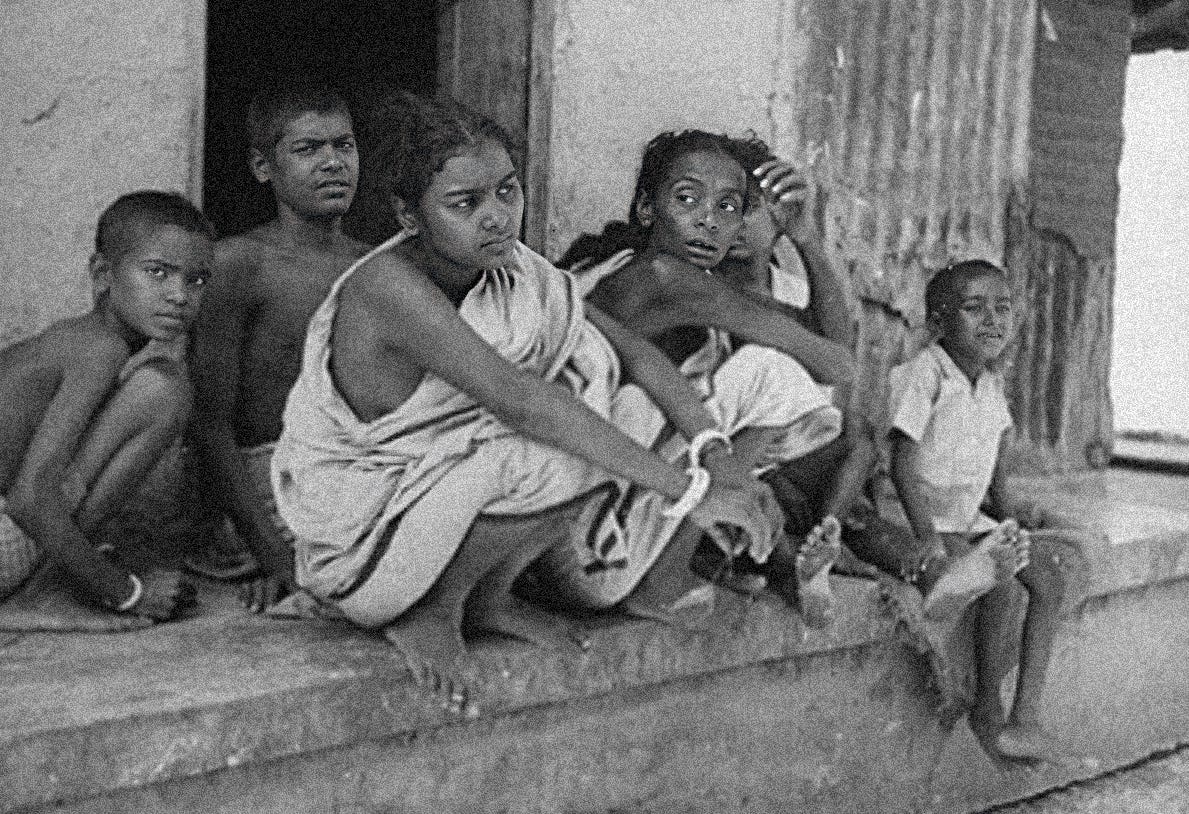
Compare this to the Bengel famine of 1943. While Stalin immediately understood the famine as a direct consequence of his collectivization efforts, Bengel’s Famine Inquiry Commission had, by 1945, already concluded that “a serious shortage in the total supply of rice” was the cause of the famine. And this remains a favorite explanation among capitalists today: thus the pro-capitalist CapX editors blame “a serious shortfall of the staple food crop of Bengal – rice.”
The historical consensus on this question has shifted, however, particularly after economist Amartya Sen famously demonstrated that Bengel had more than enough rice at the time to have avoided famine.
Sen’s analysis is often summarized as a critique of markets: there was plenty of rice, but prices were so high that the poor and destitute simply could not afford it. And this is indeed the proximate cause, but a second point Sen makes is just as important. What really crippled the government’s ability to respond to the famine was its refusal to even consider the possibility of market failure. Since the Raj knew that supply was adequate, they were caught flat-footed when starvation began to spread; and even then, their flailing response to the crisis made it clear that they had no idea what was going on. The invisible hand was supposed to fix problems like this by adjusting prices to meet demand; but since it wasn’t doing this, they could only speculate that their must be some kind of problem with supply. As Sen put it,
The government's thinking on the nature of the food problem…seems to have been persistently influenced by attempts to estimate the size of the 'real shortage' on the basis of 'requirements' and 'availability' ; it was a search in a dark room for a black cat which was not there. The approach provided no warning of the development of a gigantic famine arising from shifting exchange entitlements. It also contributed to some reluctance to accept the magnitude of the disaster even after the famine had in fact appeared.
Capitalism, in other words, created an economic system that naturally hid the cause of mass death. And the direct consequence of this was more death.
Our political discourse, nearly a hundred years later, is very good at recognizing the threat that bad decisions by state actors pose to the food supply. When the government let SNAP run out last year, for example, everyone saw it coming and everyone knew how the problem had to be solved. Meanwhile, even though communism is gone, and even though the world produced more than enough food to feed every person on the planet, more than 9 million people starve every year. I think it’s worth asking why.
Refer enough friends to this site and you can read paywalled content for free!
And if you liked this post, why not share it?


