


One of online’s funniest recurring arguments made its periodic return last week, this time on Twitter:

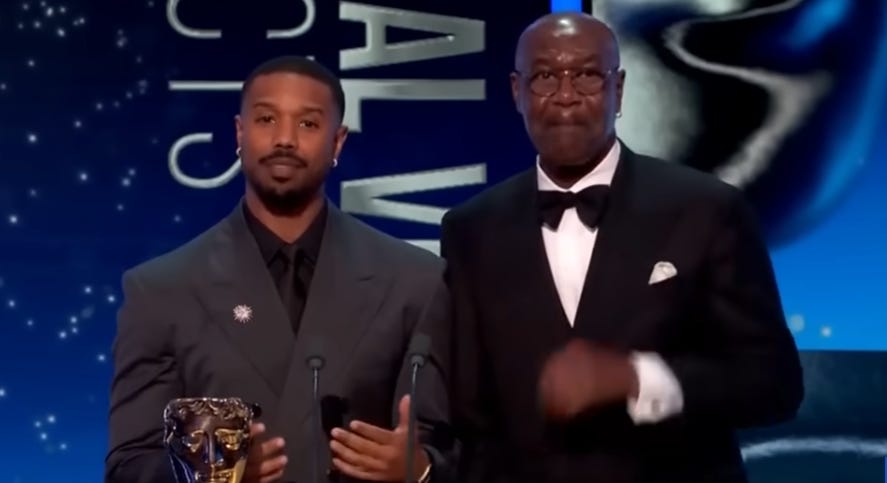
The last time this argument came up was on TikTok in 2022, and before that on Twitter in 2018. This time, at least, there was a precipitating cause: this years’ BAFTA Awards, where Tourette’s sufferer John Davidson shouted out a racial slur as Michael B. Jordan and Delroy Lindo presented an award. Still, it seems like once every election cycle the liberal-left is obligated to relitigate the same question. Are people diagnosed with Tourette’s who yell slurs — that is, people who are afflicted with coprolalia — engaged in racism?
I think there’s a reason we keep coming back to this question, but before I get to that a little background is in order.
One thing that makes this argument so fascinating, in my view, is that one of the most important points in controversy is scientifically uncontroversial. And I don’t mean this in the same way that we say climate change and evolutionary theory are uncontroversial; I mean that no one even claims there is an alternative scientific explanation.
As a matter of medical fact, coprolalia is completely involuntary. And though its anatomical explanation is complicated and technical, the general mechanisms at work are simple and intuitive. When our nervous system becomes too excited, humans often feel an irresistable urge to discharge all of that energy somehow. One way to do it is by vocalizing, which is why may you are likely to shout if you are startled or if you suddenly hurt yourself. Another way to quickly release energy is to do something that takes a lot of psychological effort — like saying a taboo word that your brain has been trained to avoid. This is why when we do yell when we’ve been startled or hurt, we often yell some profanity.
Tourette’s is that urge gone haywire. A kind of energy builds in the victim that can only be released by vocalizing, and sufferers of coprolalia are compelled to yell profanities precisely because overcoming their mental inhibitions against those words consumes so much energy.
Racism and capitalist individualism
There is, in other words, nothing intentional about the condition. That’s what makes comments like Leon Cole’s recent joke at the NAACP Image Awards so perverse: no amount of “reading the room” can prevent victims of coprolalia from expressing its symptoms. Ironically, in fact, this gets the problem completely backwards. It is precisely because John Davidson was so averse to using racial slurs, with such powerful psychological mechanisms of suppression in place against them, that coprolalia gravitates towards them.
This is why it is so bizarre that we keep returning to some of the debates about this condition. Some critics, like Cole, suggest that victims of coprolalia could stop themselves from using slurs if they wanted to, but this is completely at odds with uncontroversial science. Other critics suggest that the victims of this disease are afflicted with inner racism, and that coprolalia simply forces them to voice it; but this isn’t true either, as a matter of settled medical fact.
So why do we keep having this argument? One major explanation, I would argue, has to do with liberal ideas about individual responsibility.
