


Over the last quarter century an odd conventional wisdom has taken hold in American political discourse: leftists, we are told, are uniquely prone to withholding their vote from the Democratic Party. Before then, big election margins, abysmal showings by left candidates, and a Cold War eagerness by Democrats to distance themselves from socialist and communist candidates made that narrative less attractive; meanwhile, candidates like Ross Perot gave the GOP much more fertile soil for it to grow in. But when Ralph Nader won more votes than Al Gore’s margin of defeat in 2000, it provided Democrats with the perfect excuse: leftists should have voted blue, but they were too utopian and selfish to cast a pragmatic vote for the lesser evil. Then when Clinton escaped from a surprisingly bruising primary only to narrowly lose to Donald Trump in 2016, Democrats played the card again: this time, it was petty Bernie-to-Trump voters that betrayed them.
As a matter of both common sense and historical fact, of course, this has always been a complete sham. In American politics, even self-identified communists and aggressive critics of the Democratic Party routinely submit to the ruthless logic of lesser-evil voting. The Democrats who defect, meanwhile, tend to be ones who see themselves as occupying the “center” of the political spectrum, standing closer to the right than other Democrats: that is, centrists and moderates. Every exit poll you will ever see shows the gist of this general trend: the leftmost groups (typically marked “liberal”) go almost entirely Democratic, while the two parties split moderates and centrists. Unfortunately exit polls usually don’t get any more granular than that, and Democrats often take advantage of this to argue that if you narrowly polled the hard left, you’d see higher defection rates than among moderates. But a few pre-election polls do get granular enough to fact-check this, and the data Fairleigh Dickinson University provided me with affirms the general trend:
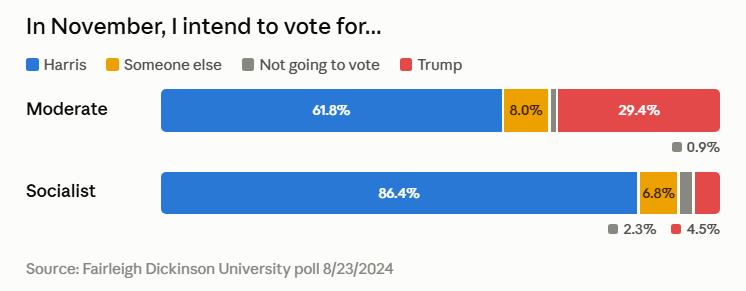
For better and for worse, this is the reality of ideological voting in the United States. Radical left voters back Democrats at levels that top even the most partisan demographic groups: America’s famously loyal black voters, for example, only gave Harris a 73% margin in 2024, while socialists gave her an 81.9% margin. Moderates and centrists, meanwhile, are infamously fickle, and are more than willing to defect to the GOP if they don’t get their way.