Zionism and ressentiment
The moral injury that animates Zionism has become a force for moral nihlism.
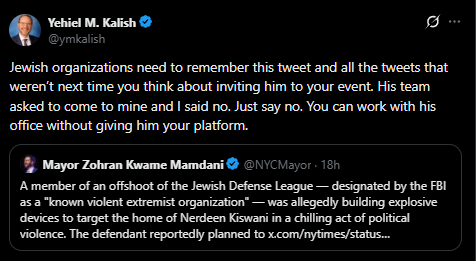
Thursday night FBI agents arrested militant Zionist Alexander Heifler as he prepared to attack Palestinian activist Nerdeen Kiswani, the Guardian reports. In the wake of the arrest, Mayor Zohran Mamdani made the statement above on Twitter, condemning the plot and pledging to protect peaceful activists in his city.
Even as I read the response above, however — and the hundreds of responses exactly like it — I can scarcely believe it. In our country, the standard reaction of the American right to any shooting or foiled act of violence is entirely predictable: blame the left or mental illness. This behavior may be odious, but it also, perversely, implies a lingering investment in conventional morality: the right still understands that assassination is wrong, or at least that it is widely perceived to be wrong, and thus they feel a need to disclaim responsibility for it. Among Zionists, however, the standard reaction has been quite different. In his response, Kalish neither distances himself from the attack or even bothers to feign regret that it happened: instead, he is simply expressing outrage that Mamdani would dare to condemn it. This is a man who simply takes for granted that Palestinians — and any opponent of the Zionist project, for that matter — deserves death. Thus, it goes without saying that anyone who would defend Kiswani’s life, even in their capacity as a mayor trying to maintain a civil peace, deserves our opposition too.
Reading this tweet, I can’t help but think of a recent interview with journalist Abby Martin. No one would accuse Martin of being ignorant or naive about Israel and the brutality of its apartheid state; she was writing about this before some younger activists were even born. Nevertheless, the psychology of Zionism is so radically alien from what we ordinarily encounter in the liberalism of civilization in the 21st century that the direct encounter with it is absolutely jarring. We are used to reactionaries who try to rationalize violence in the name of liberal committments to freedom, the rule of law, and even egalitarianism. What we do not encounter so often are reactionaries who are so disinterested in any of this that they don’t bother to bring it up.
What also strikes Martin in this interview is that the barbarism of modern Zionism isn’t some fringe divergence from a more moderate view; it’s mainstream and utterly ubiquitous. You can see this in the reaction to Mamdani as well. Kalish isn’t some anonymous teenage shitlord or even some cynical IDF soldier engaged in cyberops. He’s an accomplished and well off corporate executive posting under his real name with a real photo as his pfp. And the backlash is overrun with people who fit this exact same profile: think tank fellows like Rafael Mangual, rabbis like Elchanan Poupko, professors like CUNY’s Jeffrey Lax. One can imagine, in theory, an extremely abstract form of Zionism that sees Jews as an ethnic minority that is so uniquely persecuted that they require the special international accomodation of a dedicated security state, one that simply has not taken into account how this project has been historically implemented or the various conflicts it will inevitably have with liberal democracy. But mainstream Zionism is not naive about these questions; it is, as Martin insists, perfectly clear-eyed about the atrocities it has committed and is actively committing.
One of the clearest insights of political psychology, standing directly at odds with conventional wisdom, is that even the most radical and reactionary political movements are typically organized around a core of truth. This does not mean that their positions or platform are at all legitimate — but it does mean that these politics are responsive to something real in the lives of its partisans, and in a way that no other politics are. Consider anti-immigration politics for example. Liberalism often tells us that they are just an expression of racism, but this cannot explain why some of the most ferocious opponents of immigration are recent immigrants of the exact same race and ethnicity. What is really going on here is that workers in the United States are living lives of increasing precarity and austerity, and liberalism’s responses to this range from inadequate (meager welfare and unemployment assistance) to nonexistent (work harder!). Anti-immigration politics offer to some workers a face-saving excuse for their problems (you didn’t do anything wrong, they took your jobs) and a simple solution (all we need to do is close the borders). This is a bad diagnosis with a worse prescription, but for a lot of people it’s better than nothing.
The core of truth animating Zionism, of course, is the Holocaust and the endurance of real anti-semitism around the world. Jewish people did suffer a tragedy of apocalyptic proportions in the early twentieth century, and they do face unique danger even in the 21st century. These brute facts give the Zionist project a psychological appeal that it simply would not have if they were complete fabrications.
Left criticism of Zionism typically states the obvious: its solution to these problems has no place in liberal democracy. Instead of providing Jews with safety and justice through a regime of universal human rights, Zionism demands safety and justice through an agenda of apartheid and ethnic cleansing. What it provides, of course, is neither. Zionism has only ever made Jews less safe, and this is because, in the name of justice, it visits extraordinary injustice on the people of Palestine.
What left criticism of Zionism often neglects, however, is that the psychology we have outlined here is the textbook psychology of ressentiment. At its core, ressentiment always begins with legitimate grievance, but then a perverse logic takes hold: justice entitles one to meet injustice with more injustice. This logic is affirmed at the very foundation of Zionism, which insists that historical anti-semitism can only be met with apartheid. Once we affirm that moral premise, however, ressentiment has become legitimized, and Zionism exempts itself from any moral judgment. This is why the psychology of Zionists like Kalish feels so alien: he really does believe that he has been released from the laws, the morals, and the norms that bind the rest of humanity.
The tragic irony of Zionism is that the experience of historical anti-semitism has led many Jews to the exact opposite conclusion: instead of creating a special moral and legal regime one group, there must be a universal international regime of human rights and freedoms that protects everyone. Today’s system of international law, such as it is, was established as a direct response to the experience of the Holocaust, and if it were strengthened and upheld with any force Israeli apartheid would have no way to justify its existence.
This is why Zionism, as I have argued elsewhere, really must be understood as antithetical to the universalist project of human civilization. Its psychology is the fascist psychology of ressentiment, and its logic is the amoral logic of amoral barbarism. There is no compromise that a politics grounded in egalitarianism and universal justice can reach with apartheid and ethnic cleansing. They must simply end.
Refer enough friends to this site and you can read paywalled content for free!
And if you liked this post, why not share it?


